
Digital Health Vendor Connects to 12 EHRs in One Quarter

A digital-health Series C startup faced a contract-voiding clause from Cleveland Clinic: 14 EHR integrations within 11 weeks or the contract was off the table. The internal engineering estimate was 11 months.
Business Challenges
The Cleveland Clinic contract had been the result of nine months of design-partner negotiation. The product—a remote patient monitoring platform for cardiac post-discharge—had passed clinical validation and was ready to deploy. The contract closing call surfaced a clause the startup's CEO, Nina Pereira, hadn't fully internalized until reading the executed document: the platform had to be live across Cleveland Clinic's 14 EHR instances within 11 weeks of contract signature. If it wasn't, the contract was voidable at Cleveland Clinic's option.
Nina's internal engineering estimate to build the 14 integrations was 11 months. Her CTO had been blunt: integrations took eight weeks each minimum, the engineering team of seven would consume 70%+ of its capacity for the fiscal year, and several of the EHR instances were on older Epic versions that lacked modern FHIR endpoints. The platform's product roadmap—the foundation of the Series C investor case—would freeze during the integration work. Either the contract would be voided or the company would deliver the integrations and damage its product trajectory.
Nina raised the issue to the board. The board's response was a third option: outsource the integration work to a specialized vendor and preserve the engineering team for product work. The decision had to happen within two weeks because the deployment clock had already started.
- Cleveland Clinic contract required 14 EHR integrations within 11 weeks; non-compliance voided the contract.
- Internal engineering estimate was 11 months at minimum; the work would consume 70%+ of engineering capacity for the fiscal year.
- Several EHR instances were on older Epic versions lacking modern FHIR endpoints; HL7v2 fallback would be required.
- Product roadmap freeze would damage the Series C narrative the company had built around.
- The board mandated outsourcing the integration work to preserve the engineering team for product work; the decision had to happen within two weeks.
Solution
Nina ran the vendor selection in nine days. She had three vendor finalists. The selection criterion was specific: which vendor could commit to delivering all 14 integrations within the 11-week deadline at fixed-fee pricing, with the startup's engineering team consuming less than 15% of capacity on the work?
eCareConnect's deployment lead accepted the constraint and proposed a fixed-fee, fixed-timeline contract. The pricing was a meaningful percentage of the startup's Series C runway, but it was deterministic. The eCareConnect team would handle the EHR-specific configuration work, the FHIR / HL7 routing logic, and the production deployment validation. The startup's engineering team would provide product-side context and review the integration outputs.
What closed the procurement was the eCareConnect team's track record with Cleveland Clinic specifically. They had deployed 11 prior integrations across Cleveland Clinic instances and knew the institution's IT governance posture in detail. The startup's CTO, Marcus, called two of those prior reference customers. Both confirmed that eCareConnect had delivered ahead of schedule and that Cleveland Clinic's IT team specifically respected their work. Marcus's note to Nina: "They've done this before. We haven't. Sign it."
Value Delivered
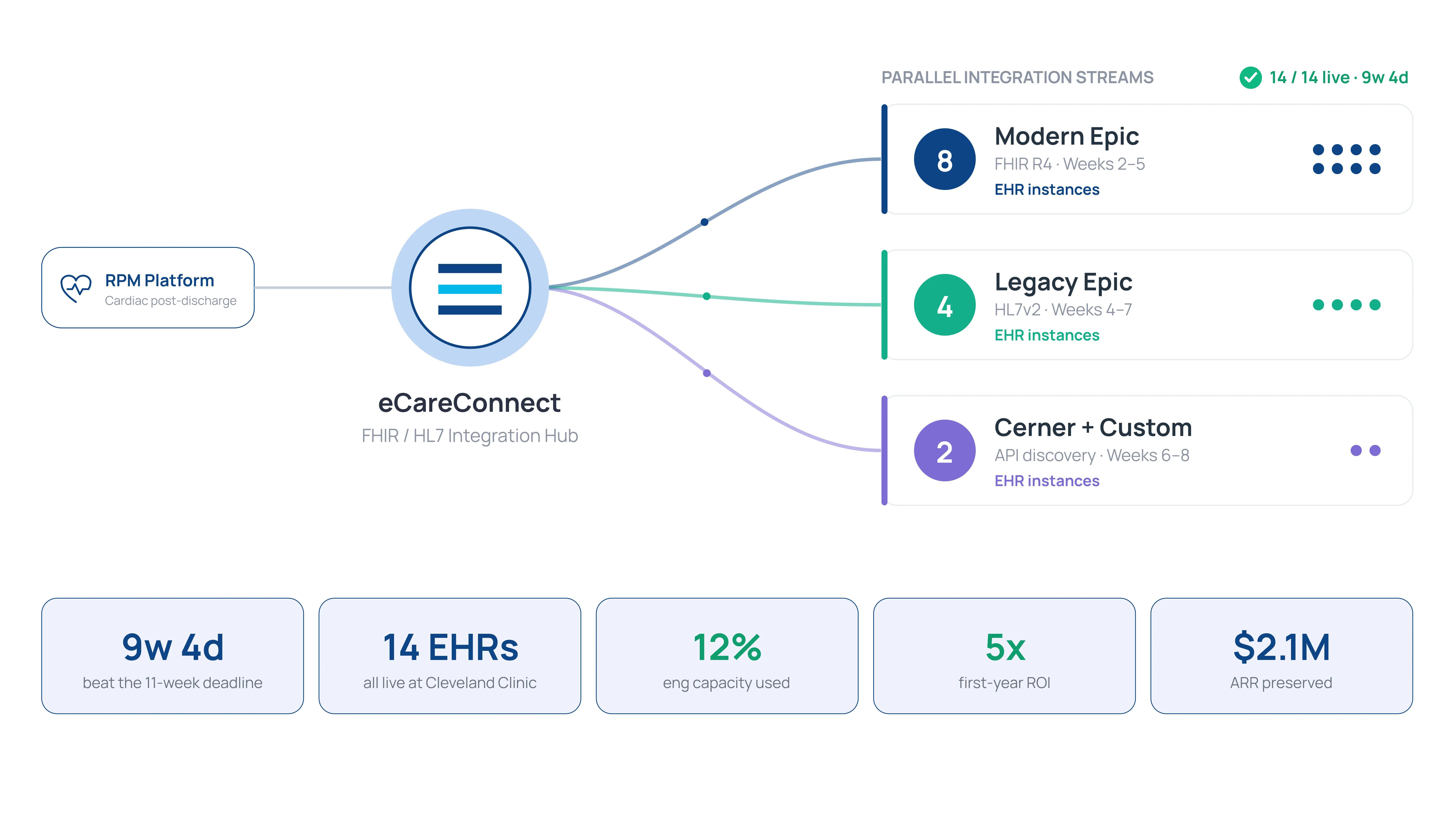
The 14 integrations went live in 9 weeks 4 days — ahead of the 11-week contractual deadline. Cleveland Clinic's IT team signed off on each integration as it went live. The deployment didn't require any contract-renegotiation conversations. The startup's engineering team had spent approximately 12% of its capacity on the integration work; the remaining 88% had been on product features.
- 9 weeks 4 days — all 14 EHR instances live, ahead of the 11-week contractual deadline.
- $2.1M ARR — Cleveland Clinic contract preserved, the contract the deadline had threatened.
- 12% — engineering capacity consumed, against the internal-build estimate of 70%+.
- On schedule — product roadmap delivered on its original timeline; the Series C narrative held.
- 0 — integration-related production incidents in the first 6 months post-launch.
Solution Provided
The deployment ran 10 weeks in parallel streams. The eCareConnect team built each integration on its own track, with shared production deployment infrastructure underneath. Daily standups across the streams kept the work synchronized.
Weeks 1–2: Cleveland Clinic IT Governance Alignment
The first two weeks were about IT governance, not engineering. eCareConnect's deployment lead worked with Cleveland Clinic's integration architecture team to align on security posture, audit logging, monitoring requirements, and the specific deployment validation process for each instance. The agreement framework was documented before any technical work began.
Weeks 2–5: Modern Epic Instances (8 integrations)
The 8 EHR instances on modern Epic versions came up first. FHIR R4 endpoints were available; the integration work was relatively standardized. By week 5, all 8 were live in Cleveland Clinic's staging environment.
Weeks 4–7: Legacy Epic Instances (4 integrations)
The 4 legacy Epic instances required HL7v2 routing. The integration work overlapped with the modern Epic stream. Some additional configuration around mirth-channel routing was needed. By week 7, all 4 were live in staging.
Weeks 6–8: Cerner Instance + Custom System (2 integrations)
The 2 non-Epic instances came up last because their configurations were more idiosyncratic. The Cerner instance was straightforward; the custom system required additional API discovery work. Both live in staging by week 8.
Weeks 8–10: Production Deployment Waves
The 14 integrations went to production in three waves of 4-5 instances each across the final two weeks. Each wave required Cleveland Clinic IT sign-off before the next wave proceeded. The third wave completed on day 67 — 9 weeks 4 days into the engagement.
Business Value
Nina's board update at the end of the engagement framed the work as risk management for the Series C narrative.
What the engagement preserved at the company level
The Cleveland Clinic contract represented 22% of the company's ARR at the time. Voiding the contract would have triggered a Series C valuation conversation. The engagement preserved the contract, the customer relationship, and the company's go-to-market story in a single decision.
What the engineering team gained
The engineering team's product roadmap was delivered on schedule. The product features that shipped during the integration window included three that became key competitive differentiators in the subsequent fiscal year. The decision to outsource the integration work to eCareConnect rather than build internally produced second-order strategic value through preserved product momentum.
The cost-benefit math
The eCareConnect engagement cost approximately $640K. The preserved contract was $2.1M ARR. The deferred engineering cost (the engineering hires that would have been needed to absorb internal integration work) was approximately $1.4M. The financial return was approximately 5x within the first year, not counting the preserved product trajectory.
What changed about the company's go-to-market posture
The company's enterprise sales team now leads with a "we can deploy across N EHRs in M weeks" claim that is operationally backed by the eCareConnect partnership. The integration capability is positioned in sales conversations as a company strength. Two subsequent design-partner customers cited integration speed as a primary selection factor.
The line Marcus uses with peers
"We had two choices. Build the integrations and break the product roadmap, or buy the integrations and keep the product roadmap intact. The second option was four times more expensive on paper. It was the right call by a meaningful margin. Engineering capacity at a Series C is not a cost. It's an asset."