
Regional Health System: TEFCA-Operational in 90 Days

A new CMO inherited a TEFCA connection commitment that her predecessor had made publicly. She had 90 days to deliver against an internal estimate of 9–12 months.
Business Challenges
Dr. Catherine Lai started as CMO of Allegheny Regional Health System in February 2025. Her predecessor—who had retired three months earlier—had publicly committed at an industry conference that Allegheny would connect to a TEFCA QHIN within his successor's first 90 days. The commitment was on a conference video. The state hospital association had cited it in two subsequent meetings. Withdrawing the commitment would damage Catherine's credibility in her first quarter.
The internal estimate for a QHIN connection was 9–12 months. The 14-hospital regional system's existing HIE connections lived in three separate adapters with different security postures. Provider attestations and treatment-of-care use case documentation needed clean policy and technical setup. Patient identity matching needed to be precise to avoid wrong-record exposure. Allegheny's IT team had limited TEFCA expertise.
Catherine's first executive meeting included a discussion about whether to withdraw the public commitment. The board chair—who had been at the conference where the commitment was made—pushed back. The reputation cost of withdrawal was specific and immediate. The cost of an aggressive timeline was uncertain but might be manageable with the right partner. The board approved a procurement process with a 90-day delivery requirement.
- Public TEFCA commitment from the prior CMO created a 90-day delivery requirement with reputation cost for withdrawal.
- The internal estimate for the QHIN connection was 9–12 months.
- Existing HIE connections lived in three separate adapters with different security postures.
- Provider attestations and treatment-of-care use case documentation required clean policy and technical setup.
- The IT team had limited TEFCA expertise; outsourcing was the only viable path within the timeline.
Solution
Catherine's procurement was structured around vendor TEFCA experience. The selection criterion was specific: which vendor had actually delivered a QHIN connection inside 90 days, with operational references confirming the deadline was met?
eCareConnect's deployment lead provided references from two prior 90-day QHIN engagements. Both reference customers—a 9-hospital system in Texas and a 6-hospital system in the Carolinas—confirmed the deadline had been met. Catherine spoke with both CMOs personally. Both confirmed the same operational pattern: aggressive timeline, deep vendor expertise on TEFCA-specific governance, and clean handover at the end.
What also closed the procurement was eCareConnect's approach to the existing HIE adapter consolidation. The three existing adapters were creating operational complexity that Catherine wanted to retire as part of the engagement. eCareConnect proposed consolidating all four endpoints (the new QHIN plus the three existing HIEs) into a single adapter as part of the engagement scope. The proposal turned the QHIN engagement into a broader interoperability cleanup that had been deferred for years.
Value Delivered
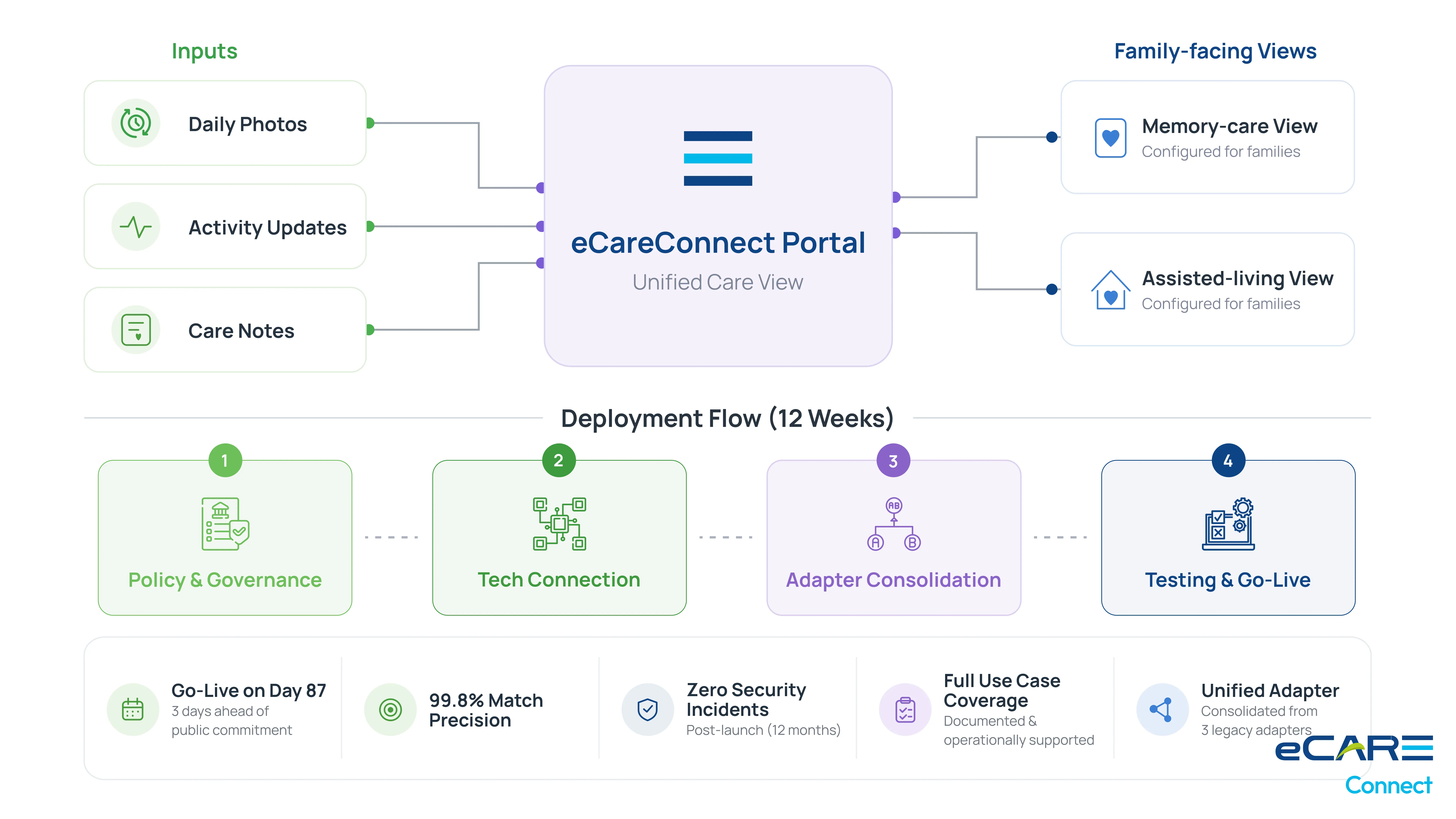
The QHIN connection went live on day 87. Catherine made the announcement at the state hospital association's quarterly meeting on day 90 — three days inside the public commitment. The technical achievement was matched by the operational consolidation: Allegheny moved from four interoperability adapters to one, with a unified security posture and consolidated audit logging across all endpoints.
- Day 87 — TEFCA QHIN connection live; public commitment delivered three days inside the deadline.
- Single — unified HIE / QHIN adapter, consolidated from three legacy adapters.
- 99.8% — patient identity match precision across all interoperability endpoints.
- Zero — incremental security incidents in the 12 months post-launch; the consolidated adapter improved security posture rather than expanding the attack surface.
- Full — treatment-of-care use case coverage documented and operationally supported.
Solution Provided
The deployment ran 12 weeks. The pacing was driven by the QHIN connection requirements, not by Allegheny's operational readiness — eCareConnect's deployment team had to maintain forward momentum even when Allegheny's internal teams had competing priorities.
Weeks 1–3: Policy and Governance Setup
The first three weeks were policy work. eCareConnect's deployment lead and Allegheny's general counsel co-authored the treatment-of-care use case documentation, the provider attestation framework, and the patient-consent posture. The policy work has to precede the technical work in TEFCA engagements; the QHIN won't admit a participant whose policy framework isn't documented.
Weeks 4–6: Technical Connection to the QHIN
The technical connection work happened in parallel with the policy review. eCareConnect's engineering team built the QHIN endpoint, the security configuration, and the audit-logging framework. By week 6, Allegheny was technically connected to the QHIN in a test mode.
Weeks 7–9: HIE Adapter Consolidation
The consolidation work happened next. The three existing HIE adapters were migrated onto the eCareConnect platform one at a time, with parallel operation during the transition so no patient data flow was interrupted. By week 9, all three legacy adapters had been retired and the consolidated adapter was carrying all four endpoint workflows.
Weeks 10–12: Patient Identity Matching Validation and Production Cutover
The final three weeks were patient identity matching validation. Wrong-record exposure was the highest-risk failure mode for TEFCA participation. eCareConnect's data team ran 14,000 historical patient records through the matching algorithm and validated against Allegheny's master patient index. Match precision came in at 99.8%; the matching algorithm went into production validation in week 11. Full production cutover happened on day 87.
The CMO's communication strategy
Catherine personally narrated the engagement progress to the state hospital association in three update emails over the 90 days. The communication kept the public commitment visible and built credibility for Catherine's tenure. The eCareConnect team's responsiveness—every milestone delivered on the day Catherine had committed to externally—gave her communication confidence to maintain.
Business Value
Catherine presented the engagement to the board in early summer 2025. The framing was that Allegheny had delivered against an inherited public commitment and simultaneously rationalized infrastructure that had been adding operational complexity for years.
What the engagement preserved at the leadership level
Catherine's first-quarter credibility as CMO held. The public commitment that could have undermined her leadership posture became a delivered result. The board has subsequently extended additional strategic latitude on other initiatives based on the demonstrated execution discipline.
What changed about Allegheny's interoperability posture
The consolidated adapter has become the single point of integration for all subsequent interoperability work. The Prior Authorization API requirement that came into effect 8 months later was implemented on the existing platform in 3 weeks. The patient-mediated exchange capability that the IT team had been wanting to build for two years was added on the same platform in 6 weeks. The infrastructure investment compounds.
What changed about the IT team's recruiting
The interoperability work has become a recruiting asset. Allegheny's IT director has hired two senior integration engineers from regional health systems specifically because of the modern TEFCA-and-FHIR posture. The infrastructure quality has become a talent-acquisition lever.
What Catherine says now
"I inherited a commitment that looked impossible. The decision to deliver it rather than withdraw it produced infrastructure we should have invested in years ago. The forcing function created the alignment to do the work that operational logic alone hadn't created. The 90-day timeline was less expensive than the 12-month timeline would have been because it precluded the slower compromises."